
Why chasing CLOSURE is BS

And how it harms your healing journey
CLOSURE ●noun●
An act or the process of closing; a sense of resolution or conclusion at the end of an experience or process.
CLOSING ●adjective●
Bringing something to an end: final
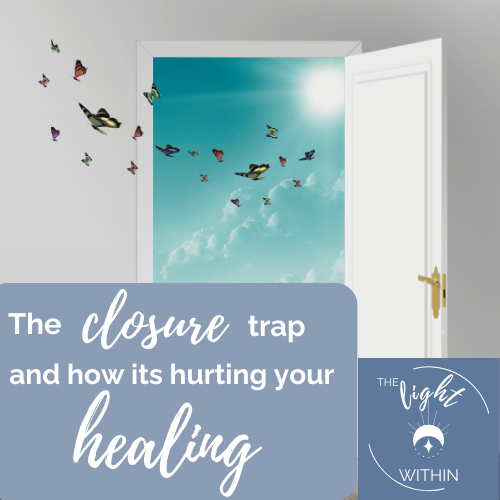
Based on the dictionary definitions above, when we talk about closure linked to trauma and grief, it comes as no surprise that most people imagine a sense of finality—a moment where everything feels neatly resolved. Closure is a concept that gets thrown around a lot and we are often told we need to find closure in order to move on with our lives, to get past the experience.
But let me be LOUD AND CLEAR and very blunt:

The popular notion of closure often suggests that healing from a major loss, trauma, or significant life event involves finding a point where we can "close the door" and move on. This concept has been fuelled by cultural narratives, pop psychology, and even legal systems, which often speak about victims or survivors finding “closure” after certain events like trials or funerals. But research and the experience of many trauma and grief survivors tell a more nuanced story.
The idea of closure sounds appealing because it implies that we can wrap up the messiness of our pain and leave it behind for good.
But here's the truth: there is no magic endpoint.
Trauma and grief don’t just vanish because you’ve reached some imaginary finish line. Life is not like a TV episode where everything gets neatly resolved by the end. Healing isn’t linear, and it sure as hell isn’t about shutting down your feelings and calling it “done.”
Psychologists have long argued that closure is more myth than reality. Dr. Pauline Boss, a pioneering researcher in the field of ambiguous loss, coined the term “ambiguous grief”, referring to grief that doesn’t have a clear end or resolution. Her research challenges the idea of closure as being something that’s attainable—or even desirable—in many cases of trauma or loss. She emphasises that it’s more about learning to live with the ambiguity and uncertainty of loss than trying to resolve or close the door on it.
Recent research has also pointed to the idea that closure can be a cultural construct, with Western societies often promoting it as an ideal end-point for emotional experiences.
In contrast, other cultures may emphasise integration, ongoing connection to the deceased, or cyclical approaches to trauma, where emotions are revisited at different stages of life. This raises an important point: what we view as “closure” is often influenced by societal expectations, rather than any universal human experience.
Closure implies finality, a sense that you can package up your trauma or grief, put it on a shelf, and walk away. It suggests you can close the door on these profound experiences, turn off the lights, and never have to deal with them again. But that’s not how it works. Trauma and grief are deeply woven into the fabric of who we are. They don’t just disappear, and trying to “close the door” on them can do more harm than good.
Instead, what we need is acknowledgment. We need to allow these experiences to be what they are—messy, raw, and often painful—and give ourselves permission to move through them. Not around them. Not over them. Through them.
It’s about integration. Our grief and trauma don’t define us, but they do shape us. We carry them with us, and how they show up in our lives depends on the healing work we’re willing to do. When we allow ourselves to truly feel and process these emotions, they settle into us in a way that feels more manageable, less overwhelming. It doesn’t mean the pain disappears—it means we learn to live with it differently.
Now, here’s where it gets tricky. If we don’t deal with these experiences fully—if we push them away in the name of closure or try to pretend they don’t affect us—they will find a way to come out. Unaddressed grief and trauma don’t just evaporate. They’ll surface in other ways, often in patterns we don’t immediately recognise.
Maybe it shows up in unexpected anger, or in the way we avoid certain relationships or situations. Maybe it manifests in physical symptoms or the stories we tell ourselves about what we’re capable of. These are the echoes of the pain we tried to shut down. And the more we suppress, the louder those echoes become until they’re impossible to ignore.
There is no doubt that the psychological cost of seeking closure can be dear. A study published in the journal Trauma, Violence, & Abuse suggests that people who fixate on finding closure may struggle more with unresolved emotions. This is because the search for finality creates additional pressure, especially in cases where closure is simply not possible—like with sudden loss or unresolved trauma. This emotional tension can prolong suffering, as individuals feel like they’re failing to heal "properly" by not reaching a state of closure.
So, what can we do? Instead of chasing closure, focus on gentle self-awareness. Pay attention to what’s coming up for you emotionally, physically, and energetically. If something feels off, don’t rush to bury it or label it as “done.” Sit with it. Feel it. Let it inform you.
One way to do this is through mindful reflection. Whether that’s journaling, meditating, or simply taking time to sit with your feelings, give yourself space to acknowledge what’s there.

Instead of striving for closure, we should be looking for how we can turn our pain into purpose, the gifts in our grief and the meaning in our experiences, which, are shit as they were, are always portals for learning, growth and self-discovery. So clichéd, I know…. But hear me out.
Research by Dr. Robert Neimeyer, a leader in grief therapy, suggests that people who can make meaning from their loss or trauma—whether through finding a new purpose, gaining insight into their own lives, or fostering a deeper connection with others—experience more sustainable healing than those who seek closure. Meaning-making allows the individual to incorporate the loss into their life story without trying to neatly “end” it.
All this takes time, so give yourself the gift of patience. Healing often takes more time than we’d like (or than we think it should). We live in an instant gratification society where we are always just a few clicks away from getting to the desired point. Healing doesn’t work that way, as much as we would love to make it all go away in an instant, the only way is through, and that takes time.
There’s no need to rush the process or pressure yourself to feel better on some arbitrary timeline. Grief and trauma have their own rhythms, and honouring that is a form of healing in itself. The goal is not to “get over it,” but to allow yourself the grace to move through it in your own way, at your own pace.
Healing isn’t about shutting the door on your grief or trauma experience. It’s about learning to live with it, in a way that feels lighter, more aligned with who you are becoming. It’s about integrating these experiences into who you are and allowing them to be part of your ongoing narrative. Healing is about learning to carry the pain differently, not pretending it can be neatly wrapped up and left behind.
By understanding these research-backed ideas, we can begin to rethink our relationship with loss and trauma. Instead of putting pressure on ourselves to “move on” or “find closure,” we can give ourselves permission to keep evolving with our grief or trauma, letting it inform our growth, rather than shut us down.
These insights reinforce the idea that closure isn’t the goal—growth and integration are. With the right tools, support, and understanding, we can work with our emotions, rather than against them, and find ways to live more fully and authentically in the aftermath of loss and trauma. This is flow: when we work with what is instead of fighting against “what we think should be”.
You don’t get to erase your trauma or grief, but YOU GET TO CHOOSE how it lives within you. And that is a powerful point in healing—the point that comes not from shutting things down, but from opening yourself up to the full depth of your experience.
With love from my soul to yours,

PS: Sign up to my members area for updates so you never miss a post, or follow me on Facebook or Instagram for inspiration and wisdom on your healing journey.
PPS: If you ready to explore your own healing journey and reconnect with YOUR Light Within, book your FREE Radical Soul Reading to unlock your inner healing wisdom and open yourself up to soul truths, blocks and limitations. And if you are ready to dive straight into healing, I invite you to see how I can be of service to you on your journey.


